Microsoft Exposes Widespread Phishing Campaign Pilfering 35,000 User Credentials Across 26 Nations
Unveiling a Sophisticated Phishing Onslaught: Microsoft's Disclosure
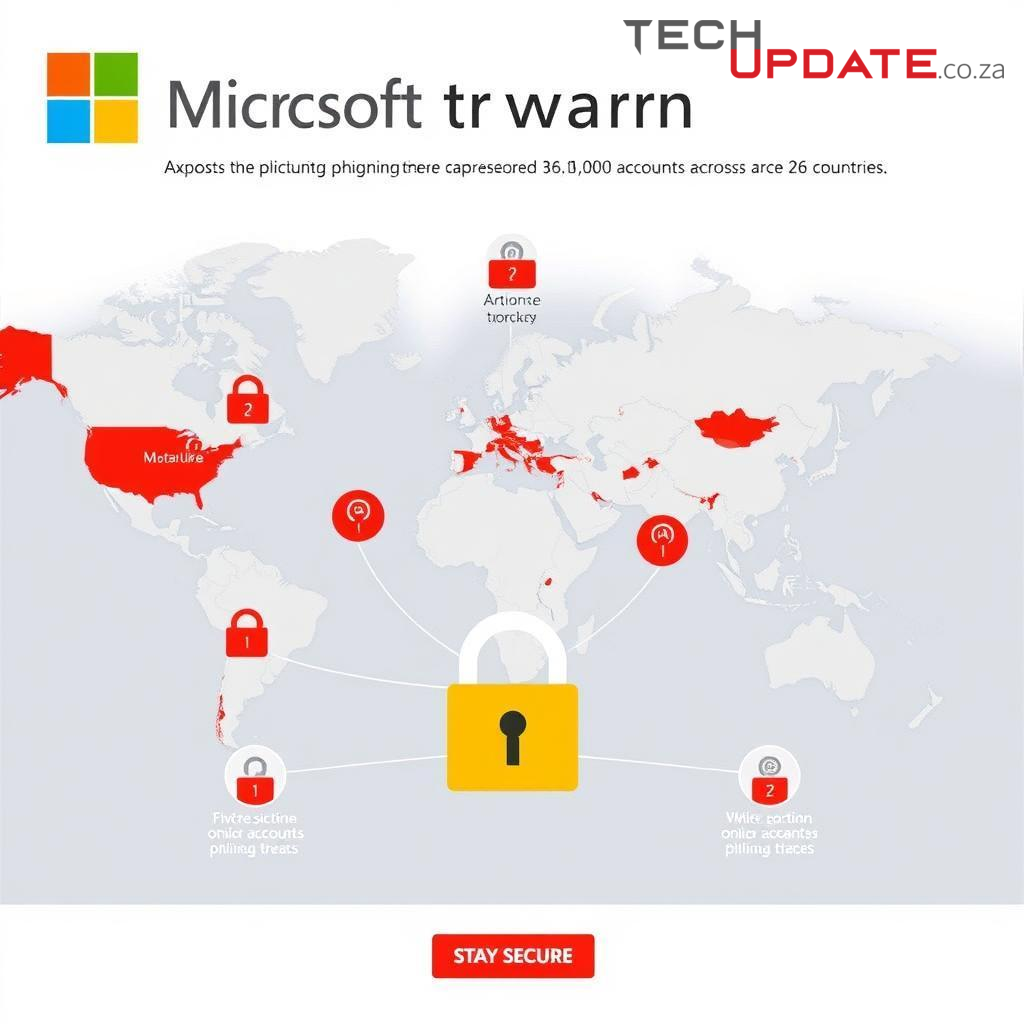
Microsoft has detailed a sophisticated, large-scale credential theft campaign that spanned the globe, impacting over 35,000 users across more than 13,000 organizations in 26 countries. Observed between April 14 and 16, 2023, this multi-stage operation utilized cunning social engineering tactics and legitimate email services to siphon authentication tokens, effectively bypassing traditional multi-factor authentication (MFA) measures.
The Anatomy of the Attack: Lures and Tactics
The attackers behind this campaign employed highly effective lures designed to exploit user trust and urgency. Emails, often themed around "code of conduct violations," urgent policy updates, or impending password expirations, were meticulously crafted to appear legitimate. These initial phishing emails were distributed via seemingly credible email services, enhancing their deliverability and reducing their likelihood of being flagged by spam filters.
Upon clicking a malicious link embedded within these emails, unsuspecting users were directed to attacker-controlled domains. These phishing sites were engineered to closely mimic authentic login portals, such as those for Microsoft services. Instead of merely harvesting usernames and passwords, the sophisticated adversaries focused on stealing session cookies or authentication tokens. This method allows attackers to hijack an active user session, granting them unauthorized access to accounts even when MFA is enabled, as the token essentially proves prior successful authentication.
Global Reach and Alarming Scale
The sheer scale of this campaign underscores the persistent and evolving threat landscape facing digital enterprises. With targets in 26 nations and a direct impact on tens of thousands of users, the operation demonstrated a significant global footprint. The rapid execution, confined to a mere three-day window, highlights the efficiency and coordination of the threat actors involved. The widespread compromise of organizations across various sectors points to a broad, indiscriminate targeting strategy, maximizing potential illicit gains.
Mitigation and Defensive Strategies
In response to such advanced threats, organizations must adopt multi-layered and adaptive security postures. While MFA remains a critical defense, its effectiveness can be diminished by token theft. Microsoft and cybersecurity experts recommend several key strategies:
- Advanced Authentication Policies: Implementing Conditional Access policies that enforce strict conditions for access, such as compliant devices or specific locations, can mitigate the risk of token replay.
- Security Awareness Training: Continuous and updated training is paramount to educate users about sophisticated phishing techniques, including those that mimic official communications and target token theft.
- Endpoint Detection and Response (EDR): Deploying robust EDR and Extended Detection and Response (XDR) solutions can help detect anomalous activity post-compromise, such as unusual login locations or access patterns.
- Token Protection: Utilizing security features that bind authentication tokens to specific device characteristics or IP addresses can further restrict their portability and misuse.
- Threat Intelligence: Staying informed about the latest threat vectors and attacker methodologies, like those detailed by Microsoft, is crucial for proactive defense.
Conclusion: A Persistent Threat Landscape
Microsoft's disclosure serves as a stark reminder of the escalating sophistication of cyber adversaries. The shift towards stealing authentication tokens rather than just static credentials represents a significant evolution in phishing tactics, demanding a re-evaluation of existing security frameworks. Organizations must prioritize holistic security strategies that combine advanced technical controls with rigorous user education to effectively counter these dynamic and pervasive threats.
Resources
- Microsoft Security Blog: 35,000 organizations targeted in phishing campaign that bypassed MFA using authentication token theft
- The Hacker News: Microsoft Uncovers Massive Phishing Campaign That Stole MFA Tokens From 35,000 Users
- BleepingComputer: Microsoft phishing campaign stole MFA tokens from 35,000 users
Details
Author
Top articles




 }})
You can now watch HBO Max for $10
Latest articles





You can now watch HBO Max for $10
Unveiling a Sophisticated Phishing Onslaught: Microsoft's Disclosure
Microsoft has detailed a sophisticated, large-scale credential theft campaign that spanned the globe, impacting over 35,000 users across more than 13,000 organizations in 26 countries. Observed between April 14 and 16, 2023, this multi-stage operation utilized cunning social engineering tactics and legitimate email services to siphon authentication tokens, effectively bypassing traditional multi-factor authentication (MFA) measures.
The Anatomy of the Attack: Lures and Tactics
The attackers behind this campaign employed highly effective lures designed to exploit user trust and urgency. Emails, often themed around "code of conduct violations," urgent policy updates, or impending password expirations, were meticulously crafted to appear legitimate. These initial phishing emails were distributed via seemingly credible email services, enhancing their deliverability and reducing their likelihood of being flagged by spam filters.
Upon clicking a malicious link embedded within these emails, unsuspecting users were directed to attacker-controlled domains. These phishing sites were engineered to closely mimic authentic login portals, such as those for Microsoft services. Instead of merely harvesting usernames and passwords, the sophisticated adversaries focused on stealing session cookies or authentication tokens. This method allows attackers to hijack an active user session, granting them unauthorized access to accounts even when MFA is enabled, as the token essentially proves prior successful authentication.
Global Reach and Alarming Scale
The sheer scale of this campaign underscores the persistent and evolving threat landscape facing digital enterprises. With targets in 26 nations and a direct impact on tens of thousands of users, the operation demonstrated a significant global footprint. The rapid execution, confined to a mere three-day window, highlights the efficiency and coordination of the threat actors involved. The widespread compromise of organizations across various sectors points to a broad, indiscriminate targeting strategy, maximizing potential illicit gains.
Mitigation and Defensive Strategies
In response to such advanced threats, organizations must adopt multi-layered and adaptive security postures. While MFA remains a critical defense, its effectiveness can be diminished by token theft. Microsoft and cybersecurity experts recommend several key strategies:
- Advanced Authentication Policies: Implementing Conditional Access policies that enforce strict conditions for access, such as compliant devices or specific locations, can mitigate the risk of token replay.
- Security Awareness Training: Continuous and updated training is paramount to educate users about sophisticated phishing techniques, including those that mimic official communications and target token theft.
- Endpoint Detection and Response (EDR): Deploying robust EDR and Extended Detection and Response (XDR) solutions can help detect anomalous activity post-compromise, such as unusual login locations or access patterns.
- Token Protection: Utilizing security features that bind authentication tokens to specific device characteristics or IP addresses can further restrict their portability and misuse.
- Threat Intelligence: Staying informed about the latest threat vectors and attacker methodologies, like those detailed by Microsoft, is crucial for proactive defense.
Conclusion: A Persistent Threat Landscape
Microsoft's disclosure serves as a stark reminder of the escalating sophistication of cyber adversaries. The shift towards stealing authentication tokens rather than just static credentials represents a significant evolution in phishing tactics, demanding a re-evaluation of existing security frameworks. Organizations must prioritize holistic security strategies that combine advanced technical controls with rigorous user education to effectively counter these dynamic and pervasive threats.
Resources
- Microsoft Security Blog: 35,000 organizations targeted in phishing campaign that bypassed MFA using authentication token theft
- The Hacker News: Microsoft Uncovers Massive Phishing Campaign That Stole MFA Tokens From 35,000 Users
- BleepingComputer: Microsoft phishing campaign stole MFA tokens from 35,000 users
Top articles
You can now watch HBO Max for $10
Latest articles
You can now watch HBO Max for $10
Similar posts




This is a page that only logged-in people can visit. Don't you feel special? Try clicking on a button below to do some things you can't do when you're logged out.
Example modal
At your leisure, please peruse this excerpt from a whale of a tale.
Chapter 1: Loomings.
Call me Ishmael. Some years ago—never mind how long precisely—having little or no money in my purse, and nothing particular to interest me on shore, I thought I would sail about a little and see the watery part of the world. It is a way I have of driving off the spleen and regulating the circulation. Whenever I find myself growing grim about the mouth; whenever it is a damp, drizzly November in my soul; whenever I find myself involuntarily pausing before coffin warehouses, and bringing up the rear of every funeral I meet; and especially whenever my hypos get such an upper hand of me, that it requires a strong moral principle to prevent me from deliberately stepping into the street, and methodically knocking people's hats off—then, I account it high time to get to sea as soon as I can. This is my substitute for pistol and ball. With a philosophical flourish Cato throws himself upon his sword; I quietly take to the ship. There is nothing surprising in this. If they but knew it, almost all men in their degree, some time or other, cherish very nearly the same feelings towards the ocean with me.
Comment